Recent Gallery


Tampilkan postingan dengan label World’s Largest. Tampilkan semua postingan

Eisriesenwelt — World of the Ice Giants

 The Eisriesenwelt (German for "World of the Ice Giants") is a natural limestone ice cave located in Werfen, Austria, about 40 km south of Salzburg. The cave is inside the Hochkogel mountain in the Tennengebirge section of the Alps. It is the largest ice cave in the world, extending more than 42km and visited by about 200,000 tourists every year.
The Eisriesenwelt (German for "World of the Ice Giants") is a natural limestone ice cave located in Werfen, Austria, about 40 km south of Salzburg. The cave is inside the Hochkogel mountain in the Tennengebirge section of the Alps. It is the largest ice cave in the world, extending more than 42km and visited by about 200,000 tourists every year.
Photo — Link
The Eisriesenwelt (German for "World of the Ice Giants") is a natural limestone ice cave located in Werfen, Austria, about 40 km south of Salzburg. The cave is inside the Hochkogel mountain in the Tennengebirge section of the Alps. It is the largest ice cave in the world, extending more than 42km and visited by about 200,000 tourists every year.
Photo — Link
The Tennengebirge mountains were formed during the late Tertiary period, during the Würm glaciation period of the Pleistocene. The mountain range, one of the massifs in the Austrian Alps, is the largest karst plateau in the Salzburger Alps, and the Eisriesenwelt is located at the rim of this plateau. Although the cave has a length of 42 km, only the first kilometer, the area that tourists are allowed to visit, is covered in ice. The rest of the cave is formed of limestone. Eisriesenwelt was formed by the Salzach river, which eroded passageways into the mountain. The ice formations in the cave were formed by thawing snow which drained into the cave and froze during winter. Since the entrance to the caves is open year-round, chilly winter winds blow into the cave and freeze the snow inside. In summer, a cold wind from inside the cave blows toward the entrance and prevents the formations from melting. 

The Eisriesenwelt (German for "World of the Ice Giants") is a natural limestone ice cave located in Werfen, Austria, about 40 km south of Salzburg. The cave is inside the Hochkogel mountain in the Tennengebirge section of the Alps. It is the largest ice cave in the world, extending more than 42km and visited by about 200,000 tourists every year.
Photo — Link
History — The first official discovery of Eisriesenwelt was by Anton Posselt, a natural scientist from Salzburg, in 1879, though he only explored the first two hundred meters of the cave. Before his discovery, the cave was known only to locals, who, believing that it was an entrance to Hell, refused to explore it. In 1880, Posselt published his findings in a mountaineering magazine, but the report was quickly forgotten. Alexander von Mörk, a speleologist from Salzburg, was one of the few people who remembered Posselt's discovery. He led several expeditions into the caves beginning in 1912, which were soon followed by other explorers. Von Mörk was killed in World War I in 1914, and an urn containing his ashes is inside a niche in the cave. In 1920, a cabin for the explorers, Forscherhütte, was built and the first routes up the mountain were established. Tourists began to arrive soon after, attracted by the cave's sudden popularity. Later another cabin, the Dr. Oedl House, and paths from Werfen and Tänneck were constructed. In 1955 a cable car was built, shortening the 90-minute climb to 3 minutes. Today the Eisriesenwelt cave is owned by the National Austrian Forest Commission, which has leased it to the Salzburg Association of Cave Exploration since 1928. The Forest Commission still receives a percentage of the entrance fees.

The Eisriesenwelt (German for "World of the Ice Giants") is a natural limestone ice cave located in Werfen, Austria, about 40 km south of Salzburg. The cave is inside the Hochkogel mountain in the Tennengebirge section of the Alps. It is the largest ice cave in the world, extending more than 42km and visited by about 200,000 tourists every year.
Photo — Link
Visiting — The cave is open from May 1st to October 26th every year. Its operating hours are 9:00 a.m. to 4:30 p.m. in July and August and 9:00 a.m. to 3:30 p.m. in May/June and September/October.  Temperatures inside the cave are usually below freezing, and warm clothing is recommended. Photography is not permitted once visitors are inside the cave. The tour begins at the entrance to the cave, and continues inwards to Posselt Hall, a large room with a stalagmite called Posselt Tower in the centre. Past the Posselt Tower, one encounters an ashen cross on the wall of the cave, marking the farthest point of exploration of Anton Posselt. From there one can see the Great Ice Embankment, a massive formation that rises to a height of 25 metres and represents the area of greatest ice growth. Next is Hymir's Castle, named after a giant in Norse mythology. Here stalactites create a formation called Frigga's Veil, or the Ice Organ. Next on the tour is the Alexander von Mörk Cathedral, one of the largest rooms in the cave and the final resting place of von Mörk's ashes. The final stop on the tour is the Ice Palace, a kilometre into the cave and 400 metres underground. From here, visitors must turn around and walk back through the caves to reach the entrance. The round-trip tour through the cave takes around one hour and 15 minutes. Wiki
The Eisriesenwelt (German for "World of the Ice Giants") is a natural limestone ice cave located in Werfen, Austria, about 40 km south of Salzburg. The cave is inside the Hochkogel mountain in the Tennengebirge section of the Alps. It is the largest ice cave in the world, extending more than 42km and visited by about 200,000 tourists every year.
Photo — Link
You might also like:     
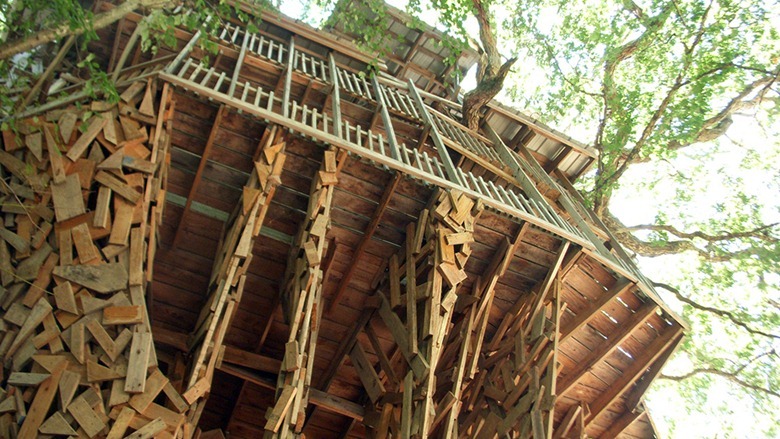
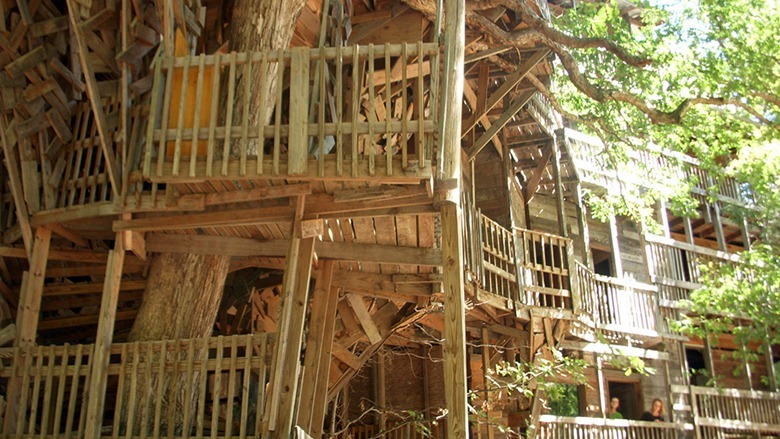
Massive Tree House in Crosville, Tennessee: The Largest in The World

A Crossville, TN (US) minister named Horace Burgess owns the largest tree house in the world. It rises 97 feet into the sky, the support provided by a live, 80-foot-tall white oak 12 feet in diameter at its base. Six other trees brace the tower-like fortress. It has some 80+ rooms and dozens of porches, overlooks, nooks and stairways. Built from scrap wood, the site stands in a rural area, but is attracting people from all over the country.

As he tells the story, in 1993, Horace Burgess was praying when god told him, “If you build a tree house, I’ll see that you never run out of material.” A self-taught carpenter and landscape architect, he has worked almost constantly on the structure since then and he's not finished yet. For fourteen years, Minister Burgess has been adding to the tree house using recycled pieces of lumber from garages, storage sheds and barns. 

The tree house has 10 floors, averaging nine to 11 feet in height and measures between 8,000 to 10,000 square feet. It is topped by a chime tower weighing 5,700 pounds equipped with 10 oxygen acetylene bottles repurposed as bells.

A homemade sign reads: "Welcome friends." Approximately 400 to 500 folks visit weekly, most of them from out of state and most of them by word of mouth.

Horace Burgess’s tree house is soon going to enter the Guinness book of records, but before that Burgess will have to provide measurements of every inch of the tree house, a daunting task that he'll likely accomplish with the assistance of his friends who have volunteered many hours on the project. Burgess has also vowed to build additions to the ramshackle structure if he is ever in danger of losing that title.
ministers-tree-house1
Photos: sssour

Largest Wooden Sculpture in the World

The power of a wood structure is defined in a striking new edifice. A wood canopy of six "parasols" has been erected in Seville, Spain. Completed last month, it was designed by Berlin architect J. Mayer H., with timber construction by Finnforest-Merk GmbH, Aichach. Metropol Parasol, is it is formally known, is built of 3,400 wooden parts, is over 90 feet tall almost 500 feet long.

16 More images after the break...

The structure is made of  interlocking pieces of wood  held together mostly with glue and with metal clamps. Costing an estimated 130 million Euros and built over the course of five years, the structure is designed as an urban icon to draw attention to Seville, and reclaim an underutilized urban area. Restaurants and shops are embedded in the towers and below the canopy. A view walkway crowns the top. Architect Mayer designed it as an entry in a competition in 2004. Mayer describes it:
 The Metropol Parasol scheme with its impressive timber structures offers an archaeological museum, a farmers market, an elevated plaza, multiple bars and restaurants underneath and inside the parasols, as well as a panorama terrace on the very top of the parasols. Realized as one of the largest and most innovative bonded timber-constructions with a polyurethane coating, the parasols grow out of the archaeological excavation site into a contemporary landmark, defining a unique relationship between the historical and the contemporary city.


Via — Text Photos
 
Support : Venus Net | Pagak City
Copyright © 2013. Great bathroom screwing - All Rights Reserved
Template Created by Together Published by Venus Net
Proudly powered by Blogger